Saturday, 17 March 2012

Australia: pre-race

Well, qualifying was bloody exciting. I slept in and so missed Q1, but did catch that Raikkonen failed to escape to Q2. This was because he made a mistake and then missed the boat to do another flying lap. As expected, HRT and Marussia filled most of the Q1 slots, but Caterham was less competitive than expected, with neither driving making Q2.

The second session was no less exciting, with Alonso doing a decent lap and the embarking on an off-road excursion to a gravel trap, which ended his qualifying. Despite this, Massa beat no-one’s time in Q2 (and only starts ahead of Perez because the Mexican didn’t complete a competitive lap). Di Resta was somewhat disappointing in 15th, and Senna did well to get his Williams to 14th. Alonso starts 12th.

Hamilton absolutely blitzed his first flying lap, which was about 0.7s better than everyone else for most of the session. He was unable to improve, and didn’t need to, nabbing a handy pole just ahead of Button. Shock of the day was Grosjean in the Lotus getting 3rd, which does make me wonder where Raikkonen could’ve been but for his mistake and how he’ll do in the race. Schumacher was surprisingly better than Rosberg, with the elder German 4th and his young apprentice 7th. Schumacher was also 0.3s ahead of Webber, who beat Vettel down to 6th. Maldonado did excellent work to get Williams to 8th, and Hulkenberg’s 9th was impressive, especially given it’s his first qualifying since that spectacular pole in Interlagos. Ricciardo rounds out the top 10.

A few musings on qualifying. Firstly, it’s very tight. There’s a tenth between the McLarens, suggesting they’ve somehow made a car that suits ragged Hamilton and smooth Button. Grosjean and Schumacher are separated by less than a tenth, and Webber, Vettel and Rosberg by less than four one-hundredths. Hedged bets in qualifying seem wise, given that.

Red Bull aren’t that quick. Well, not as quick as many expected them to be or as quick as they have been for the last two years. The real concern for them must be if they still have a qualifying premium (last year they were super in qualifying but the gap to the rest narrowed in race pace). If that’s the case they may go backwards once the lights go out.

McLaren are top dogs. It was expected they’d be there more or less, but the pace of the Mercedes and Lotus is a slight surprise. Ferrari’s car seems to be an absolute dog. Alonso might have made Q3 had he not crashed out, but Massa is well down. His days, and Domenicali’s, may well be numbered.

The Williams revival is quite a surprise, but nice to see. Sauber seemed to struggle, in 13th and 16th.

Just the one tip. I do tend to start seasons poorly, and we don’t know about reliability etc, but here it is: Schumacher for a podium, 3.4. No hedging. He tends to have monster starts, he’s been racing well, the car’s fast and the Mercedes DRS may be the best of the bunch for overtaking. Against that is that he starts on the dirty side of the track, but it’s more than 2/1 for him to make up one place.

The race starts at 6am tomorrow. I’ll try to remember to wake up for the start this time.

Morris Dancer

Friday, 16 March 2012

Australia: pre-qualifying

First of all, thanks to those who commented on the last article. As well as being nice to read some of the comments also suggested some interesting possibilities I hadn’t considered before. (NB I don’t enable comment moderation, I think it happens automatically after a certain length of time).

Nigel pointed out I’d forgotten to comment on the probably tighter-than-last-year qualifying situation. I think he’s absolutely right, not just regarding Q3, but even to escape Q1.

Marussia and HRT will probably stack up 4/7 of the Q1 slots, but there may well be a ferocious battle between Caterham, Williams and maybe others to escape the ignominy of being out in the first qualifying session.

However, it seems likely that the battle to reach Q3 will be titanic. We’ve got (if speculation is right) two top teams in Red Bull and McLaren, and none of the four drivers are rubbish. So, that leaves six slots for The Rest. Ferrari is reputed to be off the pace, Lotus and Mercedes have put in good efforts and Force India have two very talented young drivers. The lower half of the top 10 on the grid will, I think, be highly variable throughout the season and may present some opportunities.

Incidentally, there’s also the possibility of intra-team divergence. Schumacher has improved markedly regarding racing, but he’s still qualifying a league below Rosberg. However, he (Schumacher) starts fantastically, and in the latter half of 2011 was the better driver (in the race). Rosberg tends to get the most out of the car in qualifying, but this also means it’s hard for him to make up ground in the race.

We’ll have to see if this is proven true, but the Lotus and Ferrari are reckoned to be very good over a few laps, but to have high degradation (and the prancing horse is inconsistent). So, they may qualify well but then be handicapped in the race (this would also benefit Mercedes, which appears to have solved its rear tyre-shredding problem, at last).

The tyres are softer than last year (the supersoft remains the same and 2011’s medium is 2012’s hard). This may benefit Button and Vettel, and harm Webber, who found it took him a while to get to grips with the Pirellis last year.

No tip for qualifying in Australia. It’s a brand new season, and due to the timezone difference P3 is at about 3am UK time. However, I’ll run through P1 and P2.

Due to insomnia I actually listened to most of P1 and caught the back end of P2. Here’s a summary of who was where:

P1 – Button and Hamilton locked out the top places for McLaren. Almost half a second down the road was Schumacher, followed by Alonso, Webber and Rosberg. 7th was taken by Ricciardo, then came Maldonado, Raikkonen and Kobayashi.

P2 – Schumacher got the top slot, which isn’t bad for a man competing in his 932nd Grand Prix. He beat the talented whippersnapper Hulkenberg into 2nd, then came Perez, Alonso and Kobayashi. Di Resta was 6th, followed by Massa, Kovalainen, Rosberg and Vettel.

The impression I got was that the Mercedes could be good. However, P1 started off pretty damp (though there was good dry running at the end). Ferrari seems to be in trouble. Alonso was going hell for leather, and I think that was because he had to rather than because he wanted to. McLaren’s still looking good, and Vettel was 11th and 10th, which is unexpected. I don’t think that’s a pace issue, and Alguesuari (expert chap on R5 now) reckoned Red Bull was testing a new thingummyjig.

Remember, generally speaking P1 is about getting a feel for the initial setup, P2’s about getting the long run, high-fuel pace right and P3 is for final race and qualifying setup and qualifying simulation.

So, practice is fuzzy as ever, but does lend a little more credence to the consensus that Ferrari have buggered up big time, and McLaren and Red Bull are still top dogs. It also slightly suggests that Mercedes might be closer to the top two than Ferrari and Lotus.

However, Alguesuari made the interesting point that Mercedes’ excellent DRS (now married to a lovely F-duct-in-all-but-name) would really help in qualifying (available for 56% of the lap: http://en.espnf1.com/mercedes/motorsport/story/72993.html) but that, relatively, Mercedes would be slower in the race because it would be able to use the DRS far less and would lose more pace (relative to other teams) because of this.

Alguesuari also suggested that the best place to overtake is turn 3, at the end of the second DRS zone, which means that more overtaking may well be easier and that a super DRS could help a lot with that.

Unless I see something to change my mind I’m going to stick with my 2011 approach of taking P3 and its qualifying simulation as the best guide to qualifying. So, as I won’t be listening to that live and it’s a new season, I won’t be offering a qualifying tip.

The most interesting parts of qualifying will be as follows:

Will Schumacher be able to match Rosberg? In the last two years he’s been a mile behind in qualifying but looked good in practice.

Will Mercedes be able to upset the McLaren-Red Bull dominance?

How well or badly will Ferrari do?

Most importantly, who’ll get pole? A Hamilton-Webber-Vettel battle could be on the cards.

For the race, my intention is to offer 1-2 tips, but obviously that depends on odds available and how the grid lines up.

Morris Dancer

Sunday, 4 March 2012

2012 season preview

So, the testing is over, the races await, and soon the season will be underway.

Testing now is notoriously hard to analyse. That may sound like an excuse, but there are good reasons why it is not. Firstly, in 2009 we still had refuelling. This meant fuel tanks were much smaller and significantly diminished the fuel effect (the variation in lap times due to high or low levels of fuel). It was because of this that I was able to tell that there was an off-chance the Brawn team might do ok.

Secondly, the tyres. These are highly variable and degrade swiftly, making a comparison tricky. (Incidentally, the tyres this time around, excepting the supersoft, are softer compared to last year’s. This may aid Vettel and Button and prove displeasing to Webber and Mercedes).

Thirdly, track conditions. Temperature, precipitation, and time of day all affect how things run.

Fourthly, and perhaps most importantly, the teams deliberately try not to show their real pace. This was confirmed by Ferrari before testing even began.

So, what did we learn from testing?

Well, nothing definitive. The first practice sessions at Oz will provide more useful info, likewise qualifying and the race. However, we shouldn’t even take that as gospel, as each circuit is different and the drivers will be doing a race for real, for the first time, on the new tyres.

However, there are one or two interesting features. Firstly, the W-duct. This is a swanky front wing created by Mercedes, designed to maximise the advantage, aerodynamically, in both corners and on the straights. Whether it’ll work well we can’t be sure, and if it does it’ll certainly be copied.

Then we have the Red Bull letterbox, which is a little gap on the nose at the steeped bit. The team have said this is to help cool the driver, but many suspect it may (also) be there to channel air to aerodynamically handy bits at the rear, enhancing grip. As the letterbox seems to always be open, it wouldn’t, I think, fall foul of the regulations banning the driver-controlled F-duct.

A brief word on noses: McLaren reckon there’s not much different between its pretty nose and the kinked one used by everyone else, save Marussia. Nevertheless, it is striking that just two teams went for the prettier option.

There’s been a lot of musing about the state of play. For what it’s worth (and don’t take it too seriously) here are my impressions, guided by the odd inside line, keeping up to date with the news and gut instinct.

McLaren and Red Bull seem to be top dogs. It’s possible that McLaren will come out on top, which could prompt an intriguing Button-Hamilton-Vettel three way fight for the title.

Ferrari may be in deep trouble. According to their own technical director, Pat Fry, they won’t even be able to compete for a podium at the first Grand Prix (http://en.espnf1.com/ferrari/motorsport/story/72092.html). This suggests they believe they’re clearly third, or perhaps even worse. A Ferrari-Lotus-Mercedes battle for third spot seems possible.

However, a word of caution. McLaren had a dire pre-season test in 2011, but in-season their car was either fastest or second only to Red Bull.

Lotus and Mercedes seem to be pretty impressive. Whether they can leapfrog Ferrari is something we’ll find out in Oz. It appears that the Silver Arrows have resolved their serious rear tyre destroying problem, but we’ll only find out for sure over a race distance.

Further down the field, Sauber seems more or less solid and Force India seem to be in reasonable nick. Not sure about Williams. Caterham must look to score a point or two pretty regularly. HRT and Marussia (formerly Virgin) both failed to do any pre-season testing with their 2012 car, and it’s increasingly difficult to see the point of either team.

Unfortunately, there’s a new and very unwelcome challenge to betting on F1 this year, namely the Judas Iscariot approach to coverage adopted by the BBC. In practical terms, this means those without Sky will either have to find an alternative means of seeing the action or will miss half the qualifying sessions and half the races. (Excitingly you can watch highlights 14 hours or so later. Ooh).

I’m not sure if this is accurate, but I’ll post it anyway. On the comments responding to a blog written by one of the BBC’s condescending F1 editorial chumps one chap put up the details of the BBC’s coverage:

Australia - Highlights, Q 1pm/75minutes, Race 2pm/2 hours
Malaysia - Highlights Q 1pm/75 minutes, Race 2pm/2 hours
China - Live Q 6am/2.5 hours, Race 7am/3h15mins
Bahrain - Highlights Q 5.30pm/75 minutes, Race 5.30pm/90mins
Spain - Live Q 12.10pm/2h05m, Race 12.10pm/3h05mins
Monaco - Live Q 12.10pm/2h05m, Race 12.10pm/3h10mins
Canada - Highlights - 10.30pm/75 minutes, Race 11.30pm/2 hours
Europe - Live Q 12.10pm/2h05m, Race 12.10pm/3h05mins
Britain - Live Q 12.10pm/2h05m, Race 12.10pm/3h05mins
Germany - Highlights Q 6pm/75 minutes, Race 6pm/90mins
Hungary - Highlights Q 6pm/75 minutes, Race 5.30pm/90mins
Belgium - Live Q 12.10pm/2h05m, Race 12.10pm/3h05mins
Italy - Highlights Q 5.30pm/75 minutes, Race 5.30pm/90mins
Singapore - Live Q 12.10pm/2h20m Race 12.10pm/3h05mins
Japan - Highlights, Q 1pm/75minutes, Race 2pm/2 hours
Korea - Live, Q 5am/2h15m, Race 6am/3h15m
India - Highlights, Q 1pm/75minutes, Race 5.30pm/90 minutes
Abu Dhabi - Live Q 12.10pm/2h05m, Race 12.10pm/3h05mins
USA - Highlights - 10.30pm/75 minutes, Race 10.30pm/2 hours
Brazil - Live, Q 3pm/2h15m, Race 3pm/3h15m

I’m hoping that listening to P3 on the radio will be as much use, effectively, as watching it online, and hopefully qualifying bets won’t be detrimentally affected. I’ll try the same for qualifying when it’s early and see if I can watch online if it’s on a bit later. I do intend to tip shortly after P3 for qualifying and a couple of hours after qualifying for the race, as per last year, but it’s impossible to say whether this’ll be adversely affected by the lack of coverage. If I do find a decent online option (I’m going to try RTL) then I’ll probably only watch the BBC for races that are live and early (China and Korea).

There was an interesting mini-interview with Vettel on the BBC's angry wasps website. The lack of rear grip, due to no blown diffuser, reduces speeds in the corners (which is obvious), but what I hadn't considered was that this also means that it takes a bit longer to get tyres up to temperature and probably decreases degradation (this'll probably be offset or mitigated somewhat by the decreased life expectancy tyres now have).

So, for qualifying this may well mean that it's flying lap 2 or 3 that the tyre is in best shape for, and for the race it may mean that an undercut strategy (pitting early to benefit from a better tyre to get faster times and leapfrog the person ahead when they stop) may not be so simple, as the person who does not pit first could be faster on the outlap (accounting for the pitstop), increasing the gap and giving them breathing room for an immediate riposte.

Instead of one big article per race weekend I’m going back to a pre-qualifying, pre-race and post-race analysis approach. For the first race, Australia, I’ll probably not bet on qualifying, as P3 takes place at an ungodly hour, and offer 1-2 tips for the race itself. Australia race day is the 18th.

Morris Dancer

Monday, 26 December 2011

Early preview of 2012

For the first time in a few seasons 2012 won’t see a slew of massive rule changes. With luck (as always) this may help me finally start a season in the green rather than the red.

DRS, KERS and Pirelli all remain, although the blown diffusers are to be abolished (or at least reduced significantly). Here’s a brief and approximate explanation of how the blown diffuser works, and what hot and cold blowing (do stop giggling) are:

Teams have taken to channelling the exhaust gases from the engine to specifically designed aerodynamic parts, which acts to push the car into the road, improving grip. The engine can be (and has been) used to do this even when the car isn’t accelerating, substantially enhancing grip in slow corners particularly. Hot blowing is much the same, only fuel is used to heat the exhaust gases which enhances their effect.

Possibly helpfully this was banned (in a rather shambolic way) at the Silverstone Grand Prix, which was also the only one that Ferrari won (ironically it was the only race won by a car not built in Britain). Ferrari are a bit rubbish at it compared to Red Bull, and McLaren are in between.

This may help the others catch up to Red Bull somewhat, as their downforce is the very best on the circuit (more than making up for a slight lack of straight line speed or a dodgy mini-KERS unit). However, I don’t anticipate the teams being shuffled around too much. It’ll be intriguing to see how Mercedes and Lotus (formerly Renault) do in their bid to close the gap to the frontrunners.

I think roughly 70% of speed is down to the car, with 30% from the driver. However, drivers are more consistent across seasons. So, I fully expect Vettel and Hamilton to be the best qualifiers in 2012, and Schumacher to consistently be out-qualified by Rosberg.

In 2009 I enjoyed an epic (albeit Pyrrhic) tipping victory as I tipped, but didn’t back, Button before the season began at 70/1. In 2010 I had a plethora of long-term bets, almost all of which were utterly wrong.

This season I didn’t tip on title or similar bets but did make a small number that turned out green in the end. I think a sensible approach is to avoid pre-season tipping due to the low number of tests and high degree of variability (due to fuel especially), but consider such things around a quarter or a third into the season. At that stage matters will be clearer, as will the direction of travel (which teams are improving, or not) and there’s plenty of time to hedge.

I had a pretty good run on the safety car this year. I think I’m right in saying every bet on it was green. There are two big things to look for when making such a bet: the circuit, and weather. Circuits like Malaysia and Hungary are good, as there’s lots of run-off area, and Monaco and other street circuits are bad (obviously). Weather can be hard to predict, but this can also help as many people have monsoons in mind when contemplating Malaysia, but actually it’s one of the circuits least likely to have a safety car, artificially lengthening the No Safety Car odds.

Raikkonen (surely this was Raikonnen a few years ago? Or am I going mad?) is a big wild card. He varies from Absolutely Cannot Be Bothered to Staggeringly Fast, for no apparent reason. It may take him a little while to get used to the Pirellis, but I think he’ll be a bit faster than Schumacher when it comes to re-acclimatising to F1 (he’s been out a year less, he’s raced cars competitively since and he’s a bit younger). A few races at least will probably be needed, perhaps more.

It’s also important to consider in the first few races that different circuits suit different cars, so you can’t necessarily draw immediate conclusions (the first of 2012 are Australia, Malaysia and China).

Anyway, I thought a quick rundown of the teams and drivers at the end of 2011 and their prospects for 2012 might be worth doing, so here it is:

Red Bull

The champions. Less KERS (40kW and unreliable unlike the standard 60kW other teams employ), less straight line speed but absolutely top drawer downforce which enables them to use the DRS in places others can’t, partially explaining their relative qualifying advantage. Absolute pace cannot be guessed at in 2012 but the recipe of lower top speed and excellent downforce is likely to continue.

Vettel – fantastic driver. Very good qualifier, enjoys leading from the front, is capable of excellent passes (cf Monza this year). Few weaknesses, possibly uncomfortable when things are tight in the wet (cf Canada) and, weirdly, relatively rubbish at the Nurburgring (which we next visit in 2013). Rightly favourite to retain his title.

Webber – good, but not in Vettel’s league. Had some difficulty adjusting to the Pirellis and more reliability issues than his team mate, so I expect the gap to close this year. More capable of challenging in qualifying than the race, and he needs to sort his starts out.

McLaren

Excellent straight line speed, downforce good but not on a par with Red Bull. They were actually faster than Red Bull at many races but failed to capitalise, such as in Spain and Monaco. Improved strategy (including some qualifying faux pas that cost Hamilton and the Monaco disaster) needed.

Button – better than in his 2009 winning year. He’s still got his cunning tactical mind for tyres and the ability to find grip in soggy conditions when others can’t, but he’s also a great passer. Qualifying is his weakness, but towards the end of the season he was matching and sometimes beating Hamilton. Almost as importantly, he’s got a 3 year contract and has been working the team diplomatically.

Hamilton – had a slightly rough year, but it’s somewhat over-egged. Multiple collisions, some of which were not his fault and a few that were, helped him to a lowly 5th in the title race. However, at the end of the season he was qualifying and racing better. Man most likely (perhaps excepting Webber) to challenge Vettel for pole.

Ferrari

Dog of a car, mostly. Couldn’t get the medium compound (white) tyres to work which repeatedly compromised them (cf Brazil) all season. They also failed to challenge for pole throughout 2011.

Alonso – However, the very fact that Alonso was just a point behind Webber, who had the championship winning car, despite this, points to his continued excellence. Should he get a truly competitive car next year I think he’s the man likeliest to challenge Vettel for the title (partially due to his undoubted number one status at the team.

Massa – has put in some good qualifying performances but sadly is a shadow of his former self. I do not think he will remain as Alonso’s sidekick for long. It’s a real shame after his great 2008 season.

Mercedes

Played with themselves all year long (as it were. Ahem). Not fast enough to beat Ferrari, not slow enough to be seriously under pressure from a lower team. Great DRS and top speed but still shredding rear tyres. If they get that sorted and find a smidgen of performance they could join the big three, but we’ll have to wait and see.

Schumacher – Had a cracker of a race in Canada when he gained 4th and only just missed out on a podium. Although the team’s best result of the year he was beaten overall by Rosberg (perhaps due to failing to finish around a quarter of the races). His qualifying remains ropey, his starts are excellent and in the latter half of the season he was a better racer than Rosberg.

Rosberg – very hard to assess as we have no idea how good his team mate is today, relatively. His qualifying remains pretty good but in terms of race pace he’s now the second driver in the team.

I’ll cover the other teams, who are unlikely to get race wins or contest for the title or regular podium places, more briefly.

Renault – renamed Lotus next year. They’ve got a surprising lineup. Firstly, the still-injured Kubica cannot drive for them (incidentally, I’ve read that the problem is now not his hand/arm but the fact he’s been so inactive and has lost the strength, perhaps especially in the neck, needed to cope with heavy G-forces) and Raikkonen is now their lead driver. Romain Grosjean also makes a return to the team, having driven for them somewhat unimpressively a few years ago. I doubt Renault will be able to challenge regularly at the sharp end but they should be just behind Mercedes.

Force India – unsurprisingly Sutil has been axed and replaced with Hulkenberg, and di Resta retains his seat. I rate both the relative newcomers highly, and think that Force India are in a pretty good position. At certain tracks (high speed circuits, like Spa or Monza) they may spring the odd surprise. Hulkenberg’s lack of race experience on the new tyres may hinder him for the first few races, but his practice sessions this year should mean his qualifying is unaffected.

Sauber – they’re keeping Perez and Kobayashi. The team often starts pretty well but lacks the knack (or money) for full-season development. Perez is pretty good, and Kobayashi likewise, but I suspect they may be let down by their car.

Toro Rosso – not often we get teams changing both drivers, and even rarer to have it happen twice. I think Buemi and Alguersuari are somewhat unlucky to both be axed, though the latter may get the final seat at HRT (a grim fate). They’re replaced by aspiring Red Bull young guns Ricciardo and Jean-Eric Vergne. Hard to assess the drivers as Vergne hasn’t been in F1 before and Ricciardo spent a few races last season at HRT. Toro Rosso have been reasonable in 2011, and have excelled in speed traps suggesting a ferocious top speed but lacking elsewhere. Their aim must be to beat the likes of Sauber.

Williams – at the time of writing Williams have yet to announce who will partner the bank manager-pleasing Maldonado, who has not impressed with manner or skill. Barrichello seems likely to be out but Sutil, Senna, or another could take the seat. The car has not been good enough for a while, and unless they want to be overtaken by Caterham/Lotus they need to sort it out.

Lotus – renamed Caterham for 2012. They’re sticking with Kovalainen, who’s been driving well, and Trulli (probably). The team’s been the best of the backmarkers for the last couple of years but that’s not good enough. However, they do get a pleasing slice of money for their performances over the last few seasons which could help them start to actually nibble at the points occasionally.

Virgin – renamed Marussia, and featuring Glock and a new chap called Charles Pic. Most significantly, predictable yet nevertheless vaguely amusing double entendres regarding the team’s name will be a thing of the past.

HRT – rather surprisingly the 73 year old Pedro de la Rosa has gotten a drive with them. The other seat in the comedy acronym team remains vacant. The new boss, Luis Perez-Sala, has said that the team will be taking a step backwards in 2012, a statement that seems to defy all reason. How can you take a step backwards when you’re always last? Presumably this means the team will now comprehensively fail to beat the 107% rule (I use the term ‘rule’ loosely) and when they accidentally get to the starting grid their cars will burst into flames before the lights go out.

I’ll write a final preview after the final pre-season test but before the first race. Unless something dramatic happens I don’t intend to write another article between now and then.

Morris Dancer

Friday, 23 December 2011

2012 – antifrank aims ahead

Undaunted by my mediocre predictions for 2011, I am nevertheless going to have a bash at predicting what's coming up in the year ahead. This is particularly foolish given my long-held belief that the future is unwritten, but it's always useful to have something to test my expectations against.

Looking forward by looking back

In order to understand where we are going, it's first important to understand where we're coming from. 2011 has in many ways been a remarkably static year in political terms. All three parties are more or less where they were at the beginning of the year – the Conservatives may have put on a bit of support in the last few weeks, but it remains to be seen how permanent that is.

This is astonishing, given the amount of political turbulence. We have had a very ropey year for the economy, public sector strikes, riots, widespread anger at the revealed behaviour of the press, a crisis in the Eurozone that looms ever closer and a bona fide Euro-hissy fit. Yet the political barometer has barely moved, no matter how hard it has been hit.

So the first big question to ask is why public opinion is so static. And here we come into a whole load of negatives:

1. The public doesn't approve of the Coalition. It routinely gets -20 or worse on the YouGov surveys.

2. The public doesn't much like David Cameron. He has negative approval ratings with both MORI and YouGov. (But Conservatives adore him)

3. The public really doesn't like Nick Clegg. His approval ratings are so far below water that he is exploring territory that previously had been reserved for Jacques Cousteau.

4. The public doesn't rate Ed Miliband either. There is a big discrepancy between MORI and YouGov in his ratings, but both are negative (MORI is merely poor, while YouGov finds him to be very poor). In a survey commissioned by Lord Ashcroft, the word most frequently associated with him was "weird".

5. The public doesn't like the EU. Surveys show that more people want to leave the EU than remain in it. David Cameron's refusal to sign up to the latest EU treaty was enthusiastically received across the political spectrum.

6. In fact, it's very hard to find anyone or anything at all that the public approves of right now.

The net effect of all of this, when no one commands public support, seems to be that the public are following Newton's First Law of Motion, proceeding in a straight line with no outside force operating on them.

If this is correct, then we should not expect events by themselves to make much difference until sections of the public are persuaded from their current default settings by the analysis of those events put forward by one or more public figures.

The Grid for 2012

When working out what might come next, we have to think about what is likely to come up. There are five predictable events of significance, two economic, two cultural, one international.

1. The Eurozone crisis will be resolved, one way or another

But like the film Seven, this isn't going to have a happy ending. Even on a best case outcome, we are probably in for economic disruption. On a worst case outcome, we are in for an appalling time. Worryingly, the worst case outcome is not a remote possibility.

2. The UK economy in 2012 will continue to languish

It looks reasonably likely that we shall have another recession in 2012. The parties will put their competing interpretations on the poor economic performance. Meanwhile, the public will continue to feel morose as they continue to tighten their belts.

3. The Queen will enjoy her Diamond Jubilee

There will be a lot of retrospectives about the last 60 years. The public will wallow in nostalgia and monarchism. It should be a good year for the forces of conservatism.

4. The summer will be dominated by the Olympics

All the signs are that the Olympics should be a success. The construction works have been remarkably trouble-free to date. You can guarantee that there will be some crisis, scandal or media storm about them, though. An obvious flashpoint will be the transport in London during the games.

5. The US election will be on the news all year

The US election looks to be even more of a circus than usual this time around. The Republican nomination race is frankly embarrassing and will be reported as a freak show. This will have an impact on how the public see the economic and political debate here. It may even make the public feel a little more warmly disposed towards our own selection of politicians.

My predictions

That's the easy part over and done with. Now the harder part, what am I going to predict?

Boris will probably win the Mayoral election, but it will be a lot tighter than is currently assumed

Today, you can back Boris on Betfair at 1.37 (4/11). This is far too short. There has to be at least an 11/4 chance that Boris Johnson gets embroiled in some major brouhaha in the next five months, given his remarkably chequered past.

This is a two horse race. The other serious runner, Ken Livingstone, is a two term Mayor with a formidable political machine, a continuing appetite and a flair for eye-catching election promises. He has a lot of baggage, but he has been written off far too soon. Meanwhile, Boris Johnson seems to be reacting to Ken Livingstone's campaign rather than fighting a positive campaign of his own.

Boris will probably still win because he can transcend party boundaries. But at a time when Labour is polling far better than it did in 2008 when this battle was last fought, it is not a done deal by any means.

Polling this time next year won't be far off what it is now

The public seems to have formed settled views of the respective merits of the three main parties. In the absence of anything persuading them to take a fresh look, they probably won't change their opinions.

The Conservatives' poll numbers might move if David Cameron brings back peace with honour from the EU as part of the settlement of the Eurozone crisis. The direction of movement depends on whether the peace with honour is seen in the same light as Disraeli after the Treaty of Berlin of 1878 (when we came home with Cyprus) or as Chamberlain after the Munich Accord. David Cameron will not be helped by the utterly unrealistic expectations of the right of his party. On balance, I expect that the Conservatives will stay roughly where they are now.

The economy, though grim, is probably not going to change many people's votes either way. Those who wish to believe that it is the fault of the coalition's policies will carry on believing that and those who wish to believe that it is the fault of the Eurozone crisis will carry on believing that. Those who don't know will continue not to know.

From a narrow partisan viewpoint, the coalition parties may actually do better if there is a disorderly break-up of the Eurozone. Any economic fall-out will swamp the mistakes that could be laid at their door. From a national viewpoint, it would be a complete disaster.

Labour's poll numbers will move in an inverse relationship with the Conservatives'. The public seem fairly settled in their opinion of the leading Labour figures and they don't have control of events to make the political weather. However, Labour should do well in the local elections in May, now that they seem to have belatedly realised that they need to take on the Conservatives (rather than the SNP and the Lib Dems) if they are going to make progress.

It's hard to see what the Lib Dems can do to pick themselves back up off the canvass. They'll have to take Churchill's advice and keep buggering on.

Politicians will mostly stay put

This should be an excellent year to bet against senior politicians leaving their jobs. While all three party leaders have negative ratings, it would suit no Lib Dem for Nick Clegg to stand down next year, David Cameron is hugely popular with his party faithful and Ed Miliband will do well enough in the polls to keep the wolves from the door. It will be a year to bet on things not happening rather than on them happening.

This will also generally hold good at Cabinet level, but for different reasons. Because the Cabinet is an explicitly brokered coalition, Lib Dem Cabinet members will only go for the most egregious reasons (and even then, only maybe). And because Lib Dems won't lightly resign, neither will Conservatives. The next departures from the Cabinet will probably be at a reshuffle in June/July. Bets on next Cabinet departures should be set accordingly - who is the most dispensible? Caroline Spelman and Michael Moore spring to mind. Kenneth Clarke might also choose to take the next reshuffle as a time to retire. Lord Strathclyde at 33/1 might be worth thinking about too, because he is politically dispensible, should David Cameron need to dispense with him. It might be convenient to have a Lib Dem leader of the Lords, for example.

I for one am hoping that we are going to see more markets speculating on John Bercow's departure. To be clear, he will stay put, but it would be lovely to have some more ways of making interest-free high yield returns.

The minor parties will continue to miss trick after trick...

The current political mood is as toxic to mainstream politicians as I can recall. But no minor party is taking advantage of this. The Greens are invisible, UKIP are offensively graceless and the BNP are collapsing in internal recriminations. There is a glittering opportunity for the minor parties, but none of them show any signs of having any leadership capable of taking it.

... except for the SNP

Alex Salmond is very successfully positioning himself both as head of a Scottish government and as a leading internal opponent to the coalition. It's a nice trick if you can pull it off, and it seems as though he can. He is aided enormously by the dismal quality of all his local opponents.

However, he has concerns of his own. While he can retain power easily enough, the political climate has never been less promising for Scottish independence. "Independence in Europe" is not an easy message to sell when the Eurozone is circling the plughole, and leaving what at present looks like a relatively safe haven in the UK is going to be an equally tough sell. Yet he has no excuses not to hold a referendum at some point in this Parliament. No doubt we will eventually get a referendum (though not next year). But I would not bet on it passing without a very dramatic change in the political weather.

antifrank

Wednesday, 21 December 2011

antifrank's almanac – reviewing last year's predictions

This time last year, I was foolish enough to commit some predictions to pb2. It seems only fair to look at them again now with the benefit of hindsight and see how I did. My self-assessment is written in italics.

"1. Labour will prosper in the polls

In the short term, this trend will help Labour. When the public is in a hostile mood, the lightning will be directed at the parties in power. As the cuts bite deeper and taxes rise, Labour should rise in the polls. Even if the economy continues to grow, the public will feel poorer. Ed Miliband will have to work quite hard to mess this up."

Meh. When I wrote my prediction, Labour were around 42% with YouGov and polled 39% with ICM the following week. This week, Labour are around 40-42% with YouGov and polled 34% with ICM last week. So they didn't rise in the polls. Ed Miliband has not cut through in the way that he would have hoped.

"Labour can hope to win something close to an absolute majority in both Scotland and Wales with good campaigns."

I didn't see the SNP triumph coming then (though I did make a lot of money out of it a few months later). In Wales, Labour got exactly 30 out of 60 seats. If I were being cheeky, I'd give myself half marks, but the Welsh prediction was a lot easier to get right.

"2. The Greens may well become more influential

But unless Ed Miliband can turn around initial public perceptions of him, it's likely that other parties also will benefit. The Greens seem to have a major opportunity: leftwingers in particular seem to feel let down by all their regular choices. If they positioned themselves wisely, the Greens could scoop up a lot of left of centre voters who don't yet feel that the Labour party that has yet found a new direction. To date, the Greens have decided against compromising with the electorate. Do they have the vision to see their opportunity?"

Apparently not. The Greens have been conspicuous by their absence from political debate. They have only themselves to blame.

"3. UKIP should resurface

There is also an opportunity on the right. The Conservatives have got the sound money right wing vote locked up. Can UKIP exploit the cuts to its own advantage? They would need to take a populist rightwing approach, but such approaches have worked well in quite a few European countries (Belgium, the Netherlands, Italy and Hungary, for example) and UKIP could do much worse than look to continental Europe for inspiration. What they really need is an impeccable rightwing campaign that needs government spending. The armed forces, perhaps?"

UKIP barely did better than the Greens. They came second in Barnsley Central, had the minor success of holding their deposits in Feltham & Heston, but otherwise, nothing. They failed to broaden their appeal to become a populist right-wing party and failed even to make much of an impact in the biggest crisis to hit the EU in decades. A couple of snotty speeches in the European Parliament are not going to give UKIP power and influence. They urgently need to rethink their entire strategy.

"4. The Lib Dems will continue to flounder"

Not my most challenging prediction.

"Expect to see the Lib Dems retreat into hyper-localism. This may prove more effective than the major two parties expect in the local elections, but is unlikely to help them much in Scotland or Wales, in both of which they can expect to be spanked."

It didn't prove much more effective in the local elections than the major two parties expected, but Scotland and Wales were just as predicted.

"On the other hand, they might just take Oldham East & Saddleworth if they can harness the tactical Tory vote."

They could, but they mightn't.

"5. The Tories will stay in touch with Labour

Tory supporters like the cuts, at least the principle of them. The Tory poll ratings have slid gently but consistently through the last few months and will probably continue to do so while the cuts continue to bite. But I doubt the slide will accelerate and in Scotland the Tories might even get an increase in support in May. In the local elections, the Conservatives will lose a lot of seats, but perhaps not as many as might be expected, given how badly placed Labour are in so many parts of southern England."

The heading was more accurate than the detail. The Tories are currently polling considerably better than I had imagined this time last year. But the Tories lost seats in Scotland and gained local election seats in England. The trajectory for the Tories has been at the top end of my expectations for them this time last year.

"6. The AV referendum will be lost

The election will take place after two weeks of Royal wedding mania and no one cares about electoral reform. The referendum will be seen to be about Nick Clegg. If Ed Miliband campaigns hard for AV also, it might also come to be seen to be a referendum about him. At the moment, neither are voter magnets."

One unequivocal success. It's particularly gratifying to see that I was right at least partly for the right reasons.

"7. Fewer than half of my predictions will come true.

Ronseal."

Another unequivocal success!

I shall put up my predictions for next year to have rotten tomatoes hurled at fairly soon.

antifrank

Thursday, 1 December 2011

Full-season review of 2011

A mixed bag, overall, I think.

The races, especially early on when the Pirellis crumbled like cheese, were pretty good and a few were excellent (China and Canada, for example). Unfortunately we did get some processions (Monaco ended badly due to the red flag, India was boring, Valencia and Singapore likewise) but on the whole racing was good, I think.

From both a betting and racing perspective the season was reasonably good but could have been better (especially in the latter half of the season). The tale of the season was Vettel/Red Bull dominance, and this made qualifying and race betting often quite difficult.

Drivers

Vettel has gone up in my estimation, as has Button. Hamilton’s gone down somewhat, but if he gets his head screwed on right he has the speed to challenge for further titles. Alonso’s as excellent as ever but he needs a car capable of more than one victory (and Silverstone may’ve been down to a rather shambolic last minute and temporary rule change).

Massa is a shadow of the driver who competed for the 2008 title and missed out by the narrowest of margins. A combination of recovering from a serious head injury and Alonso assuming the throne once occupied by Schumacher has reduced him to an also-ran.

Webber also performed poorly, relative to his team mate, and whilst he suffered the lion’s share of reliability failures Vettel suffered likewise in 2010 but still took the title.

The Mercedes pair are the most intriguing, because it’s very hard to tell who’s better. In the second half of the season Schumacher was more impressive, although Rosberg enjoyed season long dominance in qualifying. I hope that they, McLaren and Ferrari can challenge Red Bull more closely next year.

The also-rans remain also-rans. No real shift from Lotus, Virgin or HRT, although Kovalainen did manage to occasionally get his Lotus into Q2. Hopefully the extra prize money will help them to close the gap to the midfield.

Perhaps the closest battle during the course of the season was in the midfield. Renault nabbed fifth, just four points ahead of Force India. Force India have been strong throughout, and with Hulkenberg reportedly joining them (replacing Sutil) and the strong Di Resta they’ll have two potentially great drivers for next season. Renault took off like a rocket at the start of 2011, with a pair of podiums, but their front-exiting exhaust (as well as sounding awful) was dire in slow corners and they clearly missed Kubica’s world class talent.

If the Pole can’t make the start of 2012 then I’d give Senna the seat. He’s made a few mistakes, but he’s also qualified well and worthy of a race seat, in my view.

Update: surprisingly, Raikkonen has got the nod. Team mate unconfirmed, presumed to be Petrov with the announcement due by the 10th of December.

Sauber just about fended off the Toro Rosso team to get seventh by just three points. A bit like Renault, Sauber got more points early on (Perez would’ve scored in his debut race had it not been for a purely technical infringement regarding the rear wing) but struggled more later on, perhaps due to lack of development funds. I think Perez has done a pretty good job throughout the season, and with him and Kobayashi Sauber have a decent lineup.

Toro Rosso have two cars, which is worth reminding them about because they seem to have about four potential drivers next year. Buemi and Alguersuari have both driven pretty well, but Ricciardo and Vergne[sp] are also eyeing up the seats.

Alas, poor Williams. A paltry five points, and seemingly due to axe Barrichello whilst keeping the bank-manager-pleasing Maldonado. I’m not a Maldonado fan. The side-swipe in Spa on Hamilton should’ve earnt him a serious penalty and getting penalties twice in one race for ignoring blue flags is not impressive. Raikkonen is now definitely not going to get Barrichello’s seat, so it’s unclear who will drive for the once mighty Williams.

Tracks

The start of the season seems a long way away now, especially given the sub-optimal UK coverage situation for next season. I’m not going through every race (you can, excitingly, go back and check the blog archives) but will pick out some high- and lowlights.

Bahrain –

Valencia’s chief rival for Worst Track On The Calendar. Although the reasons for the track’s absence were severe and serious it is not the sort of track that will be missed. We’re apparently headed there next year, but already that seems questionable.

China –

My worst result of the season (4 tips, 4 losers) but a very exciting and unpredictable race due to the super-fast degradation of the Pirellis. Webber charged through the field, having exited in Q1, and got himself a podium. Had the race been a little longer he would’ve certainly won.

Turkey –

No Red Bull collision, but it’s the last time an F1 race will be held there. It’s a decent rather than fantastic track, but given the state of Bahrain, Singapore, Valencia etc it’s a shame to lose one of the better new tracks.

Canada –

The longest race ever (over 4 hours) and maybe, just maybe, one of the very best. I buggered up qualifying tips badly, and it looked like my McLaren to Win tip was equally moronic when, after about 40 laps, Button was 21st of 21 cars still running. And yet he won, and there was much rejoicing.

Germany –

It’s weird and unfortunate for Vettel that (excepting for when his car didn’t finish once) his worst result was at home. For whatever reason he just can’t excel at the Nurburgring. Annoyingly, this will only prove useful in two years as Germany alternates its circuit and next year we’ll be at Hockenheim.

Belgium and Italy –

I’ve bracketed these together for two big reasons: Red Bulls making crazy passes on Alonso. At Spa Webber passed him through Eau Rouge at full speed, and the skill of both men to avoid a massive accident was breath-taking. Vettel is often criticised for being a lacklustre passer, but at Monza he pulled a great move on Alonso, even having two wheels put on the grass.

Brazil –

An allegory of the season. Less exciting than we’ve come to expect because the Red Bulls were just too damned fast. Handy for Webber that his team mate got a gearbox problem and gifted him the win.

Rule changes

I think having both KERS and DRS is a bit gimmicky, but there’s no denying they’ve often worked well. Occasionally the DRS has been too easy/hard, but it’s the inaugural year so that’s to be expected.

The biggest change was the Pirelli tyres. Sadly they became more durable (or the drivers better at managing them) in the latter half of the season, but early on it was pandemonium as the races unfolded in brilliant chaos.

Betting


Overall, I think I did ok. Bit disappointed with recent races, but I finished ahead overall, for both qualifying and the races, and that’s better than last year. Hopefully I can beat the 2011 result in 2012.


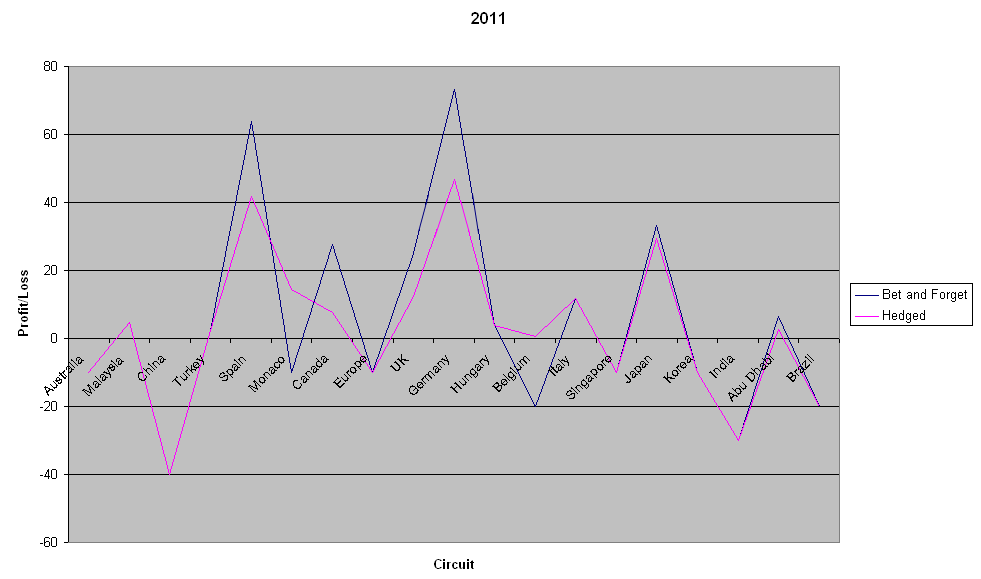
In the first half of the season not hedging was significantly better, but in the second half hedging produced a lower less. Over the entire season it was better, by far, not to hedge.

Morris Dancer