Saturday, 22 August 2009
Qualifying and race predictions
It’s a McLaren front row, Hamilton 1st, Kovalainen 2nd, and neither should have immediate difficulties as they have KERS and the cars behind them (Barrichello, Vettel, Button) do not. Sixth placed man Raikonnen is the next chap with KERS and could easily leapfrog Button and Vettel early on if he starts well.
Mark Webber starts in a disappointing 9th, which won’t do his chances of claiming the Drivers’ title much good but will help Button as the Aussie is his closest rival. Looks to be a great weekend for the English but a bad one for Australia. How terribly sad.
Hamilton is rightly favourite to win. Hard to pick out podium spots as it’s easy to see a large number (down to Raikonnen at least) having a realistic shot. However, I’m surprised Kovalainen’s odds of winning are as long as 8.8. It’s true he’s not as good as Hamilton and has a record of disappointing, but he’s second on the grid with KERS so he should finish the first lap at least in second place and with a good start could even overtake Hamilton early on.
Vettel rather spoilt P3 when his car decided to urinate a huge stream of oil over the track, an indication of the new regulations (limited number of engines per season) and the toll they’re beginning to take. Although arguably the most talented driver out there, Vettel has failed to finish in 40% of the Grand Prix so far.
He crashed out in Australia when he got clumsy with Kubica’s car, spun in Malaysia, had an accident in Monaco and suffered suspension failure in the last race in Hungary.
With Vettel’s high failure rate, Webber starting in ninth, McLaren suddenly rising to dominance, Brawn recovering (at least in the heat of Valencia) and an 18.5 point cushion still Button looks set fair for the Drivers’ title. Of course, he could crash in the first corner, but assuming nothing crazy happens I think this race may mark the comeback of Brawn and Button.
Apologies for my cock-up on the main site, here’s a link to the starting line up:
http://news.bbc.co.uk/sport1/hi/motorsport/formula_one/results/7921108.stm
Morris Dancer
Friday, 21 August 2009
After the first of three practice sessions Brawn looks a little better
The first practice session of the European Grand Prix (Valencia) saw Brawn achieve 1st and 4th with Barrichello topping the timesheets. McLaren also continued their good run with Hamilton 3rd and Kovalainen 2nd.
Red Bull had reasonable performance (5th for Vettel, 8th for Webber), and it is only a free practice rather than qualifying so only a limited amount can be read into it. Barrichello had an issue late into the session getting into gear and over the 90 minutes Button complained about both understeer and oversteer, problems which didn’t stop him coming 4th.
The race also sees the return of Ferrari’s Luca Badoer who last raced in Formula One a decade ago, and the debut of Renault’s replacement for Nelson Piquet: Romain Grosjean.
Only Brawn or Red Bull can win the Constructors’, and only Button, Vettel, Webber or Barrichello can take the Drivers’ title. Button still enjoys a healthy 18.5 point lead despite a string of poor performances.
If the first free practice session is a generally accurate indicator I think Button’s lead will either stay as is or increase after the race (ie, he’ll finish ahead of Webber and possibly Vettel as well). Hamilton seems likely to get a podium and possible a second consecutive win.
After this there are only six more races, so if Button can get a 20 point+ lead again it would give him an enormous advantage. Brawn may even win the Constructors’ where they lead Red Bull by 15.5 points. We’ll have to wait and see how the next two practice sessions, qualifying and the race goes, but come Sunday evening it should be apparent whether Brawn are back, or if Red Bull are poised to overtake Button and Brawn in the title races.
Morris Dancer
Saturday, 15 August 2009
Waves on the Electoral Tide – a punters guide
The point of this article is to inform the punter when looking at individual constituency odds compared to UNS. What would fair odds be if the fluctuations were random? They're not totally random, but it gives you a starting point (like "evens" for a seat that would fall exactly on UNS) from which to work.
Background – skip this if you’re familiar with the issues around using UNS
One of the biggest warnings about using Uniform National Swing (UNS) for predictions is that the swing is never uniform nationally. In the past, it was often assumed that the deviations from UNS would cancel out. In the round.
Yes, Constituency A which should have fallen on UNS didn’t (
John Curtice blew that idea out of the water at the last General Election, as highlighted by Mike recently on the main blog. The key point is that the assumption only holds if the variations in swing needed are spread pretty uniformly. So for every constituency overshoot of 3%, there would be as many seats in danger as would be saved by a constituency undershoot of 3%. And that’s not true. If more are "in reach of the waves" above the line of UNS than below, then the fluctuations should cause more extra seats should fall (those above the line) than those below the line to fail to fall, giving a net bonus to the swing - as occurred in 2005. Conversely, if the distribution has more "in reach of the waves" below the line than above, there would be a net underperformance.
Another key assumption is that the variations are essentially random – that an overshoot in a seat 2% further than the UNS would reach is as likely as an equal overshoot in a safe seat or hopeless seat. Likewise with undershoots. If a party were to concentrate its overshoots in marginals and undershoots in safe seats and hopeless cases, they would have a happy Leader on the Friday morning after the election. That's targeting, basically. Each party attempts to skew the overshoots in its own favour – Labour with more success than the Tories in the 92, 97 and 01 elections; in the 05 elections, the Tories had a little more success in targetting than Labour and noticeably more than the Lib Dems. Thiscan have an effect of shifting the entire electoral tide (“sea level”) by up to about 1% over the average swing (with poorer performances in non-battle seats).
There will be a random element, of course, but demographics, comparative local party strengths, local MP incumbency (especially good MP? Tainted by expenses?) and other local and regional factors will be prominent in increasing or decreasing the chance of the seat being held or falling. This is where you make your judgement call to adjust the odds produced assuming randomness.
There’s one more rather minor assumption – that the UNS (which is the overall swing from one party to another over the entire country) will be equal to the average swing of all constituencies. Which appears to be trivial on the face of it, but actually isn’t – and isn’t quite true. Because constituencies vary in size, it would only be true if the big constituencies behave exactly the same as the small ones – if the
INCORRECT ASSUMPTION 1: Uniform spread of marginality so fluctuations cancel out. This is where the need to measure the fluctuations comes in – the tables at the end of this article.
INCORRECT ASSUMPTION 2: Fluctuations are random around the average. This is where your judgement comes in - it's an opportunity for the punter
INCORRECT ASSUMPTION 3: Average = UNS.
All of this is now well accepted, but it’s all qualitative to this point. A punter needs something quantitative to help inform the betting strategy. Most specifically – how big are the likely fluctuations? What kind of overshoots and undershoots are probable? In short, how high are the waves on the electoral tide?
There have been comments on the main site that “such-and-such seat would never fall due to local factors”. The local factors are all very well, but there is an electoral tide and this article should show how much effort is needed to beat it. In addition, it should indicate just how far from UNS you can realistically look for betting opportunities.
Standard deviation
I’ve had a look at the size of the swings and fluctuations in the last five elections to get an idea. In order to show the size of the statistical noise – the variability – of a distribution of numbers (like the distribution of swings across all constituencies), mathematicians tend to use “standard deviation”. It’s also important to know what shape the distribution is. This is helped by a rule of thumb that the larger the distribution, the more it tends to the famous Bell Curve of the “normal distribution”. Looking at these elections, the swings seem to come out rather bell-curve-y all right, which means that we can say what the standard deviation means here:
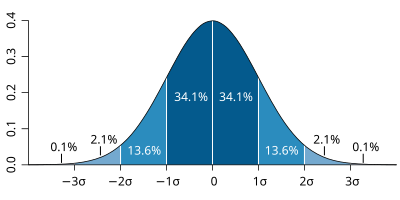
(Image from Wikipedia)
68.27% of results are within 1 standard deviation above or below the mean.
90% of results are within 1.645 standard deviations of the average
95% of results are within 1.96 standard deviations of the average (as it happens, this is exactly what “Margin of Error” on opinion polls represents)
99% of results are within 2.576 standard deviations of the average
99.73% of results are within 3 standard deviations of the average.
There will be 633 632 mainland
430-435 seats with performance within 1 standard deviation of the swing,
135-140 between 1 and 1.645 standard deviations,
30-35 between 1.645 and 1.96 standard deviations,
24-26 between 1.96 and 2.576 standard deviations,
4-5 between 2.576 and 3 standard deviations,
1 or 2 “freak” results further than 3 standard deviations from the average constituency swing.
That’s in either direction, of course. But the crucial question is – how big is one standard deviation?
Fluctuation size:
For Lab-Con swings: standard deviation should be about 3%. The average standard deviation has been 2.89% (maximum of 3.44% in 1997, minimum of 2.36% in 2005). In 2010, with a big UNS expected, I’d expect a slightly bigger than average standard deviation, so I'm setting 3% for this standard deviation.
For Con-Lib swings: standard deviations again about 3% (but very fractionally higher than Lab-Con swings, on average). Average standard deviation of 3.14%, maximum 3.34% (1987), minimum 2.97% (1997).
For Lab-Lib swings: standard deviation between 3.5% and 4%. Average of 3.77%, maximum 3.95% (1992), minimum 3.60% (2001).
So, in terms of odds. Work out how much swing is needed for the seat to fall. Compare to UNS. Leaving out the constituency size issue (which blurs it by a quarter to a half a percent either way, usually favourably to Labour), a seat where the swing required is exactly equal to the UNS would be – all things being equal – an even money shot. Exactly 50:50. That’s your baseline – you then judge from whatever factors you like whether that seat is more or less likely to fall. Region? Local strength? Which party will have superior targeting? Tactical voting and voting unwind? That kind of stuff. But you’d start from evens and adjust from there.
So I've put together a table showing the baseline starting odds in the Con/Lab battles.
Baseline Odds
Look at the swing required. Adjust for your best guess of targetting marginals and constituency sizes - add or subtract up to about 1.5% at most. Then cross reference below to get your starting odds, before you move them for local factors.
Or to put it another way – work out where the electoral tide has risen to and have that as the new “sea level”. The table below gives you the size of the waves (and troughs) – and how rare they are at that scale and you can use your judgement (based on local factors) as to the chances of them appearing at the constituency in question.
In the tables below, I’ve presented suggested “fair baseline odds” of the fluctuations being that large (if it were random). The percentage chance of falling is artificially precise – we don’t actually know yet what the standard deviations will be so I’ve estimated them – and I’ve made the translation into odds as “transparent” as possible so that you can make them more or less precise as you see fit. (Click on tables for larger image)
Conservative-Labour swing and Conservative-LibDem swing (estimated standard deviations of 3.0%)
*Treat the extremes with great caution – if the standard deviation is a bit off, it doesn’t take much to turn that 43/1 shot at 6.0% overshoot required into 11/1 (for 3.44% standard deviation) or 90/1 (for 2.36% standard deviation). The italicised area of the table is the area that most has to be used “with caution”- especially for Lab-Con swings (the LD-Con swings tend to have more regular fluctuations)
So for a seat which (adjusted) UNS says should be reduced to a 6% Labour majority, then your baseline odds on it falling should be 5/1 before using your judgement on local factors. For a seat where the Tory should be swept in with a 6% majority (needs to undershoot the swing by more than 3% not to be taken), the baseline odds should be 5/1 against the Labour incumbent holding.
Labour-LibDem swing (estimated standard deviation of 3.8%)
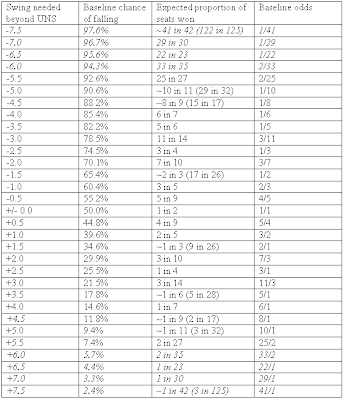
So there you have it. Use with care, as with all mathematical tools - but hopefully this will give a good starting point for each constituency analysis. The kind of thing I'm aiming for is: "XX should be 10/1 - poor local party performance, MP tainted by expenses, that region looking better for the Tories ... say 5/1. While YY should be 1/2 on, but strong local party performance, good local MP, demographics bad for the Tories ... call it evens".
Good luck.
Andy Cooke
(EDIT - Tables were initially wrong way round - now corrected)
Thursday, 13 August 2009
Brown and out whenever he will?
There are effectively three possibilities: Gordon Brown stands down or is replaced before the next election; Gordon Brown stands down following the election; Gordon Brown does not stand down in the timeframe.
Before the election
Perhaps the most telling indication of Gordon Brown's failure as a leader is that it is those posters and commentators who are not irredeemably opposed to Labour who are keenest to see him replaced. Conservative posters and commentators in particular are eager to see him in place for the election. Labour loyalists who are also loyal to Gordon Brown are very few and far between. In the press, only Mary Riddell in the Telegraph seems to be truly loyal to Gordon Brown.
That in turn would suggest that Gordon Brown should be very vulnerable. There are two danger points for him: the party conference and early in the New Year with equal dangers of both.But for all that logic dictates that he should be replaced, I think that he will survive to fight the election, for the following reasons:
1) No one has the cullions
This could more politely be labelled loyalty. But the great and the good had a gilt-edged opportunity to push Gordon Brown out of the door in June when James Purnell resigned. Either Alan Johnson or David Miliband could have ensured this. Both declined to do so. There is no obvious reason why they should act now when they failed to act then. They have both missed their best chance.
2) The prisoners' dilemma
Indeed, it gets worse. While either could have acted in June without much blame attaching to them - they would have been seen as taking the tide at the flood rather than orchestrating the coup - any move now by either David Miliband or Alan Johnson will be seen as a leadership bid. If David Miliband acts, Alan Johnson probably gets the job. If Alan Johnson acts, David Miliband probably gets the job.
Alistair Darling is in a separate category since he doesn't have leadership ambitions, so far as anyone can tell. I can imagine him resigning if he thought it best for party and country, and bringing Gordon Brown down. There is no obvious reason to expect him to do so now, however.
3) The fear of something worse
The Cabinet may fear that they will head for certain defeat under Gordon Brown. But it could be even worse if the Labour party disintegrates into internal faction-fighting in advance of an election. There would surely have to be a contested election this time. It would be a brave man or woman who predicted that would pass without incident between the candidates or their proxies.
4) Peter Mandelson
Following the failed June coup, Peter Mandelson has secured for himself a position of unparalleled influence for a senior minister. Except in the unlikely event that he himself became the next Prime Minister, he will lose that position under any successor of Gordon Brown's. This means that any plotters will need either to win Peter Mandelson round (good luck with that task) or fight against him as well as Gordon Brown. I expect that Peter Mandelson would fight, fight and fight again to save the position he loves.
It follows that I see Gordon Brown stepping down before the next election only if he decides to do so of his own free will (and Peter Mandelson fails to persuade him to stay in office). If he does so, again I expect it will be at either the party conference or early in the New Year, with equal probabilities of both.
Someone clearly agrees with my conclusions, if not my logic. The "Brown days" market on SPIN has jumped sharply in the last week, suggesting that someone thinks that the odds of Gordon Brown going early have dropped markedly.
The next election
There is a subsidiary question wrapped up in this, which is when the next election will be. This post is going to be long enough, so I won't go into all those whys and wherefores, but May 2010 is the heavy favourite and in my view justly so. The rest of this post assumes that the election is in May 2010 except where explicitly stated otherwise.
Of course, Gordon Brown might win the election. Don't laugh. It's not impossible. "Winning" in this context includes Labour being the largest party in a hung Parliament. In those circumstances, Gordon Brown is almost certainly safe for the rest of the year.
While it must not be discounted, I do not place great credence on this, seeing it as much more likely that Labour will either lose or lose badly. What then?
At this point, it is important to look at the terms of the bet on Betfair. I place a high probability on Gordon Brown announcing that he is stepping down on election night if Labour lose, just as John Major did. However, the Betfair bet pays out when he ceases to lead the Labour party, not when he announces his departure. This means that the Labour party electoral timetable and Gordon Brown’s chosen date of departure are the critical elements.
I regard it as unlikely that he will immediately hand over to Harriet Harman on an interim basis. Gordon Brown would be the first former Prime Minister since the second world war to step down so abruptly after an election defeat. Even John Major served as Leader of the Opposition for a few weeks. No leader of the Opposition since the second world war has stepped down abruptly after electoral defeat either.
Gordon Brown would have an eye to his legacy and would not want to be seen to be letting the party down after leading it to defeat. Even if he decided to hand over - my expectation - I personally doubt that he would do so in a rush. He would recall that Michael Howard’s much delayed replacement was rather successful for the Tories and that Michael Howard received favourable press for how he handled it. I expect Gordon Brown would stay in office until the next party conference at the earliest and possibly longer.
If Gordon Brown announces on election night that he is standing down at the party conference, will angry Labour MPs come with pitchforks to get rid of him sooner? I simply can’t see it. Why start internecine warfare about someone who is already political history?
Even if I am wrong, if Labour lose in a May election next year, my expectation is that he’ll stay in office at least until a leadership election is held. The candidates will need to secure nominations from MPs and that will surely mean Parliament will need to sit and new MPs will need to be canvassed. Won’t that take him into July at the very earliest?
Consider this timetable: http://news.bbc.co.uk/1/hi/uk_politics/6457597.stm
The most likely election date is 6 May 2010. Hypothetically, Gordon Brown announces that he will stand down in the early hours of 7 May 2010. (Tony Blair announced his resignation on 10 May 2007). Looking at this timetable, that would suggest that Gordon Brown would eventually step down before the end of June 2010. However, Parliament would (I think) only return on 13 May 2010. Nominations could not close too quickly after Parliament's return, since Labour MPs would want to time to discuss properly among each other who they would nominate and candidates would want the chance to canvass the nominating electorate. I suggest that the very earliest that nominations could close is 20 May 2010, and given that there will be some new Labour MPs who would need more time than the old lags to make up their mind, I suggest that 27 May 2010 is at least as likely. In that case, Gordon Brown would step down on 1 July 2010 if the same timetable is followed - ie, Q3. Now, you may disagree with me that extending the timetable in this way is likely. But some probability must be ascribed to it and it doesn't seem that negligible to me.
I regard the chances of Gordon Brown leaving office as party leader in April-June 2010 as substantially overstated.
In my view, it is likely to occur only if:
(1) Labour suffered an election defeat in a March election and Gordon Brown decides to stand down immediately;
(2) Gordon Brown resigns with immediate effect on election night; or
(3) Gordon Brown resigns and the Labour party electoral timetable is set in motion without delay.
The third of these is the most substantial possibility to my mind, and I place no more than a 1 in 4 chance of this outcome coming to pass. The single most likely possibility in my mind is that Gordon Brown would step down at the next party conference. If that is in September, that makes Q3 2010 a clear favourite in my mind and the Betfair prices look very tempting. I have been participating when the prices looked particularly good. My view is that the prices for Q2 2010 are simply wrong.I have had the courage of my own convictions and also factored the optimal Labour course of action into my betting. My current position therefore is to lay Apr-Jun 2010 and to back later periods at the right price. I am therefore light green for periods up to and including Jan-Mar 2010, deep red for Apr-Jun 2010 and deep green thereafter.
I look forward to being told just exactly how I've got this completely wrong. But as the title of this piece suggests, Gordon Brown is in far greater control of the date when he ultimately stands down as leader of the Labour party than is commonly appreciated - he controls the date of his resignation, the date of the election, the decision whether to remain as interim leader. Anyone who doesn't factor all of this into their thinking is taking a big risk.
antifrank
Tuesday, 11 August 2009
Scotland's Swing Seats SNP v Labour in the East
At the General Election, now expected to be held in May 2010, out of Scotland’s 59 seats, as many as 31 could change hands.
Since 2005, Scotland has voted 3 times, at the Holyrood and Council elections in 2007 and at the European elections in 2009. Every 4 years all Scottish councils elect all councillors simultaneously using the STV multi-member ward system and Holyrood a mixture of “first past the post” for 73 constituency MSP and 8 regional lists each electing 7 additional regional MSPs from party lists.
As polls have varied since 2007 but few Scotland only polls have been taken I have predicted outcomes on the basis of the SNP polling 30-35%, Labour 30-35%, Tories 20-25% and LibDems 10-15%. The problem predicting Westminster results is that few Holyrood seats resemble the 2005 created Westminster ones and the Council boundaries rarely match the Westminster seats either.
Here are the 5 Labour v SNP “battleground seats” in the East of Scotland.
Aberdeen North: (Lab) held by Labour’s Frank Doran, one of their more able Scottish performers. In the 2007 Holyrood elections (where Aberdeen is represented by 3 seats), North was an SNP hold with a 6.6% Lab-SNP swing increasing the majority to 3,750 or 15%. Central a Labour hold saw a 2.1% Lab-SNP swing shaving the majority to under 400 votes or 1.8%. It is hard to see Labour holding this one.
Dundee West: (Lab) remained Labour when East went SNP and held by James McGovern with a majority of over 5,000 in 2005 but in 2007 popular local councillor Joe Fitzpatrick turned Labour’s 2003 majority of 1,000 into an SNP majority of almost 2,000. I expect the SNP to throw the kitchen sink at this seat in 2010 so expect an SNP gain, especially as the city council is now SNP run. This seat falling would make Dundee the first city in Scotland ever to be SNP controlled at Westminster, Holyrood and city council level.
Glenrothes: (Lab) the seat which Labour held in last year’s by-election on a quadrupling of the postal votes and then the marked register promptly disappeared. Incredibly the Labour vote increased from 2005 but away from the media frenzy and party workers coming from all parts of the country, will the SNP be able to benefit this time from running the council and holding the Holyrood seat since 2007? The 3rd and 4th party votes are likely to return to normal so will Labour or the SNP benefit from the lack of squeeze?
Edinburgh East: (Lab) a seat long held by Dr Gavin Strang, one of Labour’s most able Scottish parliamentarians, in 2005 he retained the seat with a majority of just over 6,200 votes or almost 16%. The Holyrood seat which is smaller was taken in 2007 by Kenny MacAskill, now the very high profile Justice Secretary in the SNP cabinet on a swing of 13% giving the SNP a majority of almost 1,400 votes or just over 4.6%. Gavin Strang is retiring and Labour was rocked by outrage over the imposition of a women-only shortlist so if the SNP take any Edinburgh seat it should be this one.
Livingston: (Lab) was for some years the seat of the late Foreign Secretary Robin Cook who won the seat in 2005 with a majority of over 13,000 votes or 30%. Following his sudden death soon after the General Election, he was succeeded by Jim Devine his former election agent who held the seat at the by-election. However having suffered a 10% swing to the SNP, Jim Devine’s majority was reduced to less than 2,700 votes or 9% making it highly marginal. Sure enough at the Holyrood election in 2007, Cllr Angela Constance who just failed against Jim Devine captured the seat from Bristow Muldoon the sitting Labour MSP on a 7.5% swing giving her a slender majority of 870 or just over 2.6%. Facing an SNP opponent boosted by the presence of an SNP MSP and SNP run council, Jim Devine is like Canute trying to hold back the tide. Of course Jim Devine will not be defending the seat due to him being barred by Labour’s star chamber over his expenses so that may be enough for an SNP gain.
Monday, 10 August 2009
Is food political?

Back in the 80's when I was at University doing an agricultural degree at Reading, we dwelt for a time on human motivations as proposed by Abraham Maslow in his 1943 paper 'A Theory of Human Motivation'. You can read all about it for yourself here
In short, Maslow suggested that people have ever more complex needs and motivations but in order to become personally fulfilled, people need to progressively conquer in turn 'Physiological needs' then 'Shelter & Safety needs', 'Social needs', 'Esteem' and finally the rather grandly-termed 'Self-Actualization' or fulfilment.
So what's this got to do with politics?
Politics is all about appealing to peoples' self-esteem and desires for fulfilment... but people are only listening to these grand ideals when they feel safe and secure at home within a stable social structure.
The recession and unemployment has made people focus on the the lower-level but more fundamentally important needs. Like not being hungry.
I'm not suggesting that the shelves at Tescobury's are going to be empty any time soon but the Government doesn't seem to be recognising that people are more open to messages about basic needs than they were. They haven't twigged that luxury 'eye catching initiatives' such as elevating Sir Alan Sugar to the peerage or promoting more 'equalities' are simply missing the point.
And that's why I think that Shadow Agriculture Minister Nick Herbert is onto something when identifies that we've become more dependent on food imports in the last decade. He's tapping into a subliminal sense that we haven't placed sufficient strategic importance on ensuring that we can feed ourselves. Yes, he's making a political point, but he's also addressing a more fundamental viceral need embedded in the human psyche. The need to be able to provide for ourselves.
He reports that since 1997
* The UK’s self-sufficiency in indigenous food has fallen from 82% in 1998 to 73% in 2008;
* The UK trade gap in food, feed and drink has widened by 52% in real terms between 1998 and 2007 to £15.2 billion;
* Over 36,000 hectares of planted land for vegetables has been lost under Labour, falling from 153,000 when they took office to 116,000 in 2008;
* Over the same period, the area of land for producing fresh fruit has fallen from 36,000 hectares to 28,000 hectares;
* The number of dairy cows has fallen from 2,453,000 to 1,909,000;
* The number of beef cows has fallen from 1,911,000 to 1,670,000;
* The number of pigs has fallen from 7,834,000 to 4,714,000;
* The sheep and lamb flock has fallen from 43,983,000 to 33,131,000;
* The number of poultry kept has fallen from 169,901,000 to 166,200,000;
* The area of land for cereals has fallen from 3,358,000 to 3,274,000."
Arguably, it's the role of Goverment to put food in the belly and keep the lights on at home. Yet as I look forward to the grand challenges ahead, food security and energy security seem to have been totally overlooked. Or Fudged. And people are starting to notice this basic failure of Governance brutally exposed by the different economic situation.
This post isn't some sort of special pleading for the farmers or the oil barons, but I do observe that Labour's lack of attention to basic human needs characterised by its abandonment of the countryside and its failure to plan ahead for the time that our North Sea reserves are depleted is about to come back and bite it.
Well, we've all got to eat.